
History
Early days
Leuchars Estate can trace its origins back to the 12th century when a motte-and-bailey castle was built to the north of what is now Leuchars village. Robert de Quincy is credited with building the castle, and its first explicit reference occurs between 1306 and 1329 when King Robert I divided the lands of Leuchars into three distinct baronies.
The castle was taken and then demolished by the Earl of Pembroke in 1336 and, while Edward III ordered the castle to be rebuilt, it is unclear how much was done as it was levelled again(!) a year later by Sir Andrew Murray. Early in 1337, Scottish military and political leader Murray marched through Fife, destroyed the tower of Falkland, took Leuchars Castle and, having laid siege to St. Andrews Castle for three weeks, took that as well. It was one of the final flourishes in his support of King David II of Scotland during the Second War of Independence as he died the following year having fallen ill at the siege of Edinburgh Castle. While Leuchars Castle was rebuilt in the 16th century, the ruins were demolished in the 20th century by the Earl of Crawford and all that remains today is a large mound. However, it may have hosted royalty at one point as Tentsmuir had been named as a Royal Hunting Forest during the 12th and 13th centuries.
A cottage, meanwhile, to the north of Leuchars Castle was built in 1740. Come the 19th century,
it was extended into what is now Craigie Farmhouse, the centre of operations for the various businesses on the estate today.


Changing of the land
In the early 19th century, the area between Leuchars and Tayport was flat and marshy and the band of heavy clay soil through Craigie formed the bottom of what was known as Candle Loch. The name Leuchars comes from the Gaelic word luchair, meaning ‘place of rushes’ – a small insight into the topography. Indeed, it is rumoured that you could once row a boat the mile from Craigie to the Rhynd over what is now productive farmland. Prisoners captured during the Napoleonic War were used to dig drains to dry the loch up and put the land into agricultural production. It wasn’t until tractors were used that this heavy ground could be ploughed, though.
Leuchars Estate
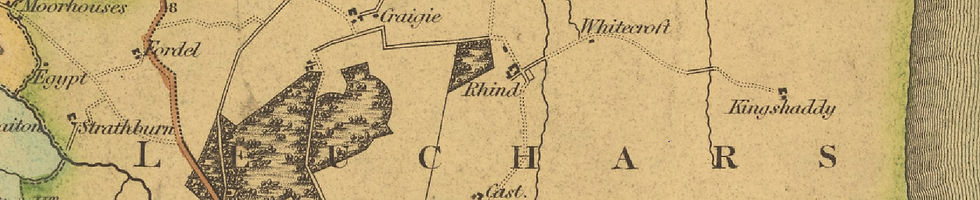
Originally owned by the Crawfords of Balcarres, in the mid 19th Century Leuchars Estate stretched from Morton Lochs in the north, to Guardbridge in the south. The farms – Craigie, the Rhynd, Cast, Milton and Leuchars Castle – were tenanted out to the likes of John Mathie, and most probably his father before him in the early 19th century. A famously strong man, John is perhaps best remembered for having five of his ploughmen banished to Australia (another joined the navy, avoiding the penalty).
The crime? Stealing potatoes from the shed. While John apparently put up a strong plea to have the matter dropped, the five men were sent to the other side of the world. Such was the renown of the story, it inspired a well-known song, The Ballad of Craigie (see page 17). The lyrics are particularly bleak with sentences of 14 years, tears "tricklin down", and the boys being marched through Perth on the way to Botany Bay. It doesn't help that the tune is equally as bleak!
John Tomson was a tenant during the 1841 census, after which William Syme took over and farmed it until 1926 when Andrew Small arrived. Fast-forward to 11 November 1972 and John Foster took over the farms – now only the Rhynd, Craigie and Leuchars Castle – with his wife Clarinda.


Life in the 19th and 20th centuries
It was hard work back in the 19th and early 20th centuries – Craigie was the second largest farm in Fife, after Kincaple, and it used 12 pair of horse – and conditions were tough with no electricity, no bathrooms and cold, long days.
The Grieve ‘Jeck’ Kirkcaldy was known for using wheat bunches as a mattress, which he then covered with a sheet. When getting up in the morning he’d pull a handful of straw from beneath his wife to get the fire started. History doesn’t relate whether the marriage lasted.
The cattle were taken to market in Dundee from Newport pier on a Fifie fishing boat and such was the amount of cotton cake and linseed the Symes bought for the cattle, every cart from all their farms was kept busy for days emptying the boat at Tayport harbour.
The Second World War left a mark on Craigie, as it did on so many places. RAF Leuchars, just three miles away, was home to Coastal Command and lived under the constant threat of German bombing. A decoy airfield was built at Craigie and Vicarsford with large flat grass fields chosen to the east of Craigie Farm.
An ‘A’ pattern series of runways were cut in the grass and were accompanied by several small huts, a flashing red beacon and a few personnel with trucks and vans. Dummy aircraft were also added to further entice potential bombers away from the real base at Leuchars. No enemy bombs were dropped on the dummy airfield, although it did fool an RAF Whitley bomber that nearly landed here while looking for Errol, some 30 miles to the west.
A mile to the west, though, a bomb was dropped near the old fever hospital, now Pinewood Lodge, probably jettisoned by a plane before heading back over the North Sea, the bomb only damaged a bit of stone dyke. Not everyone at Craigie escaped the terrors of war, though. Farm hand Eck Mackie was tasked with taking a Bedford lorry of straw to the Guardbridge paper mill. As he pulled out, a German raider strafed the village, puncturing Eck’s lorry and leg. A woman from the village wasn’t so lucky and died in the attack.
With the country emerging from the war, the mechanised future awaited, and Craigie was only one of 12 farms in Fife to have a combine. The Massey Harris 21 would attract people from miles around when it was in action and the St. Michael's-Tayport road would come to a standstill. It must have been quite a sight and sound when it fired up.


More recent times
With the arrival of John and Clarinda Foster in 1972, there was heavy investment in many things, especially the drainage, clearing the ditches dug by the Napoleonic prisoners of war some 170 years earlier.
The farm flourished with a mix of arable and livestock. Over the years, the sheep and cattle were sold, and John concentrated on wheat, barley and oil seed rape with the help of long-time farm manager Robert Aitken who lived at the Rhynd Farmhouse, now used as short-term accommodation for wedding guests. There was also previously a dairy at the Rhynd, but that was closed down when the looming cost of updating the milking parlour came in the 1960s. The building itself, almost entirely built from asbestos, was removed in 2019.
The cottages were turned into short-term lets, and then into longer-term ones, while John also built Drumoig Golf Course on ‘the hill’. Another diversification project included the Scottish Clay Shooting Centre, which opened in 1999. He was never idle, and combined all of this work with running Park House in Aberdeenshire, and freelancing for the likes of British lifestyle brand Mulberry.
The land was farmed for many years by Allan Myles on a contracting basis. On his retirement, the farm was taken back in hand. After a career in motorsport journalism at Autocar Italia, Motor Sport Magazine and then Goodwood, John's youngest son Ed moved north in 2018. By that stage, the Rhynd café and events space were open, as was the Craigie livery stables. Within a couple of years, Rhynd Fitness was launched in an empty field with a few stones, tyres and logs.
Other insights into the past
The earliest recording of human activity on Leuchars Estate dates back to the Mesolithic period (10,000-4000BC). In the 1960s, R.D.M. Candow and others discovered flints that were exposed by molehills on the Craigie Hill (now Drumoig Golf Course). All those years ago, these artifacts would have been on the coastline (which has since moved 2.5 miles to the east), which drew the experts to the conclusion that it was a seasonal camping area. Other finds included end-scrapers, burins (engravers), awls (small pointed tools used for piercing holes in leather), hammerstones, polishing and grinding stones, hearths and stake holes, which were used to fasten wind breaks.
The excavations also found fish bones from cod, haddock, turbot, sturgeon and salmon, while there were remains of red and roe deer, wild cattle, wild boar and hedgehogs. It's believed that 40-50 people used the site all those years ago.
The land was further shaped 8200 years ago by a massive multi-phase submarine landslide (the Storegga Slide) off the continental shelf of Central Norway. It caused a tsunami to hit the coastlines of west Norway and Scotland, and at Craigie, the beaches/dunes left by the Late Devensian glacial period were filled with peat bogs. The largest of these is what we now call the Silver Moss in St Michael's Wood.
The Tentsmuir area is also covered in Neolithic, Bronze Age and Iron Age sites and many fragments of pottery have been found, most notably at Earlshall Castle, where a fine corded beaker was discovered in the 19th century. There was also an engraved Norman bronze bowl found in a field at Leuchars Castle in 1923 which now resides in the National Museum.
Leuchars Estate has been shaped by thousands of years of history, whether tsunamis or world wars, and, despite the setbacks, it has survived. The land makes for good farming ground, and the recent additions of the event space, clay shooting ground, forest rooms, livery stables, café and gym have somewhat secured the future. Above all, it is home to the Foster family, and one they care deeply about. The fourth generation will soon be helping to run things.